Convening a special general meeting (SGM) is a critical task for any organization, whether it’s a corporation, a non-profit, or a homeowner’s association. These meetings are typically called to address urgent matters that cannot wait for the annual general meeting, making clear and compliant communication absolutely essential. A well-crafted special general meeting notice template ensures that all members are properly informed, legal requirements are met, and the meeting can proceed smoothly without challenges to its validity.
Effective communication around an SGM prevents misunderstandings and fosters transparency among stakeholders. Without a precise and timely notice, decisions made at the meeting could be challenged, leading to costly delays and potential legal complications. This article will guide you through the intricacies of drafting a robust notice, helping you understand the key components and best practices to ensure your next special general meeting runs without a hitch. By the end, you will have a comprehensive understanding of what makes an excellent special general meeting notice template.
Understanding the Purpose of an SGM Notice
A Special General Meeting (SGM) notice serves as the official communication to all eligible members or shareholders about an extraordinary gathering. Unlike regular annual meetings, SGMs are called for specific, often urgent, reasons that demand immediate attention and decision-making outside the normal operational cycle. These reasons might include significant organizational changes, amendments to bylaws, major financial decisions, or the removal or appointment of directors.
The notice acts as a formal invitation and a legal document, informing attendees of their right to participate and vote on the specific matters at hand. It sets the stage for a legitimate meeting, ensuring that all participants are fully aware of the agenda and the decisions that will be discussed. A clear and timely notice is the foundation for transparent governance and member engagement.
Legal and Regulatory Requirements
Issuing an SGM notice is not merely a formality; it is often a legal imperative dictated by corporate statutes, association bylaws, or specific regulatory frameworks. Most jurisdictions have strict rules regarding the timing, content, and method of delivery for such notices. Failing to adhere to these requirements can render the meeting’s resolutions null and void, opening the organization to legal challenges.
These regulations typically specify a minimum notice period, ensuring members have sufficient time to review materials and plan their attendance. They also often detail the exact information that must be included in the notice, such as the date, time, location, and the precise wording of resolutions to be voted upon. Understanding and strictly following these rules protects the organization’s legal standing and the legitimacy of its decisions.
Key Information to Include
A comprehensive SGM notice must contain several critical pieces of information to be effective and compliant. Omissions can lead to confusion or invalidate the meeting. A strong special general meeting notice template will always prioritize clarity and completeness.
Essential elements typically include:
- Organization’s Name and Contact Information: Clearly identify who is calling the meeting.
- Type of Meeting: Explicitly state it is a “Special General Meeting.”
- Date, Time, and Location: Provide exact details for both physical and virtual attendance, if applicable.
- Purpose of the Meeting: State the specific, detailed agenda items or resolutions to be discussed and voted upon. This is paramount, as only these items can be addressed.
- Eligibility to Attend/Vote: Clarify who is entitled to participate and vote.
- Proxy Information: Details on how members can appoint a proxy to vote on their behalf, including deadlines and forms.
- Supporting Documents: Information on where to access relevant reports, proposed amendments, or financial statements.
- Contact Person: A designated individual for members to reach out to with questions.
- Date of Notice and Signature: The official date the notice is issued and authorized signatory.
Benefits of a Clear Notice
Beyond legal compliance, a clear and well-structured SGM notice offers numerous operational benefits. It fosters a sense of professionalism and transparency, enhancing member trust and participation. When members understand exactly why a meeting is being held and what will be discussed, they are more likely to attend and engage constructively.
A clear notice also minimizes disputes and challenges to meeting outcomes. It provides a definitive record of what was communicated, reducing ambiguity and preventing claims of insufficient information. Ultimately, a strong special general meeting notice template contributes significantly to good governance and efficient organizational decision-making.
Crafting an Effective Special General Meeting Notice Template
Developing a reliable special general meeting notice template is an investment in your organization’s operational efficiency and legal compliance. Such a template streamlines the process of calling future meetings, ensuring consistency and reducing the risk of oversight. It acts as a standardized framework that can be quickly adapted for various specific scenarios while maintaining all necessary elements.
The goal is to create a template that is both flexible enough to accommodate different agenda items and rigid enough to consistently meet legal and internal requirements. This approach saves time, reduces administrative burden, and provides peace of mind that every SGM is properly announced. A thoughtfully designed template becomes an invaluable asset for any entity.
Essential Elements for Your Template
A robust special general meeting notice template should incorporate placeholder text and clear instructions for customization. This ensures that no crucial detail is ever missed, even when deadlines are tight. Consider including fields for all the key information discussed earlier, along with specific guidance.
Key template components include:
- Header and Branding: Include your organization’s logo and official letterhead.
- Date Line: A clear space for the date the notice is issued.
- Recipient Line: Generic address (e.g., “To All Members/Shareholders”).
- Subject Line: A prominent and clear subject, such as “NOTICE OF SPECIAL GENERAL MEETING.”
- Meeting Details Section: Dedicated fields for Date, Time, Location (including virtual access details).
- Agenda Items: Bullet points or numbered list for each specific resolution, often requiring exact wording as per bylaws.
- Proxy Instructions: A distinct section detailing proxy submission, deadlines, and a link or attachment for the proxy form.
- Supporting Materials: Instructions on how to access relevant documents (e.g., “Documents available at [Website URL] or by request”).
- Quorum Information: A reminder of the quorum required for the meeting to proceed, if applicable.
- Contact Information: A clear contact person and details for inquiries.
- Official Signature Block: Space for authorized signature and title.
Best Practices for Distribution
The effectiveness of a special general meeting notice template hinges not just on its content but also on its distribution. Ensuring that all eligible parties receive the notice in a timely and legally compliant manner is paramount. Organizations often utilize multiple channels to maximize reach and confirm delivery.
Common best practices for notice distribution include:
- Compliance with Bylaws: Always follow the methods prescribed in your organization’s governing documents (e.g., mail, email, publication).
- Timely Delivery: Adhere strictly to minimum notice periods, often ranging from 7 to 21 days, as mandated by law or bylaws.
- Proof of Delivery: For mailed notices, consider certified mail with return receipt. For email, utilize platforms that provide delivery and read receipts.
- Digital and Physical: Offer both electronic (email, member portal) and physical (postal mail) options to accommodate all members.
- Website Publication: Post the notice prominently on the organization’s official website or member portal.
- Record Keeping: Maintain a meticulous record of when and how notices were sent to each member for audit and legal purposes.
Avoiding Common Pitfalls
Even with a strong special general meeting notice template, certain pitfalls can undermine the meeting’s legitimacy. Awareness of these common mistakes can help organizations proactively avoid them. Diligence in execution is just as important as the template itself.
Some frequent errors to avoid include:
- Insufficient Notice Period: Sending the notice too late, violating statutory or bylaw requirements.
- Vague Agenda Items: Not specifying the exact resolutions to be voted on, which can lead to invalid decisions.
- Incorrect Eligibility: Sending the notice to ineligible members or, worse, failing to send it to eligible ones.
- Incomplete Proxy Information: Omitting details necessary for members to properly appoint a proxy.
- Lack of Supporting Documents: Not providing access to necessary background materials, hindering informed decision-making.
- Incorrect Delivery Method: Using a distribution method not approved by bylaws or law.
- Failure to Keep Records: Not documenting the sending process, making it difficult to prove compliance if challenged.
Sample Special General Meeting Notice Template
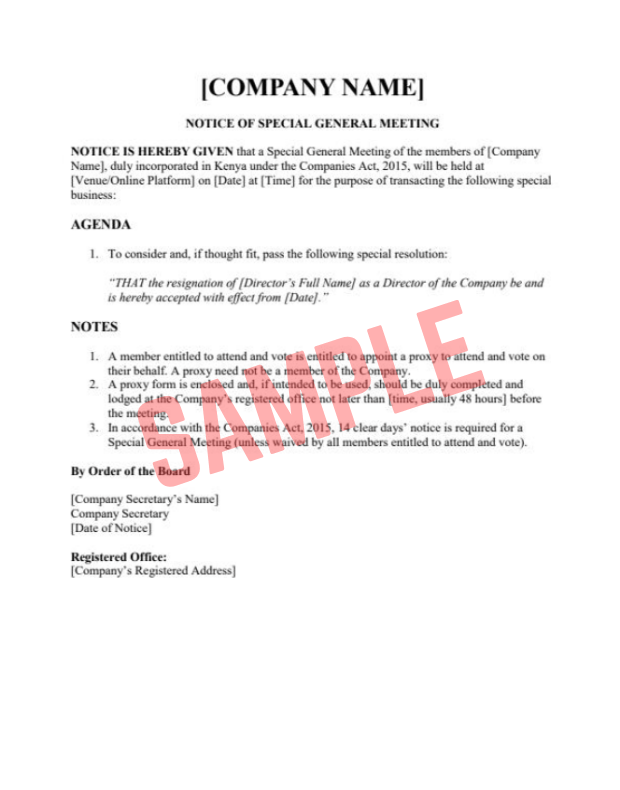
Below is a comprehensive sample that can be adapted to create your own special general meeting notice template. Remember to replace all bracketed information [ ] with your organization’s specific details.
[ORGANIZATION LETTERHEAD/LOGO]

[Date of Notice]

To All [Members/Shareholders/Unit Owners] of [Organization Name],

NOTICE IS HEREBY GIVEN that a Special General Meeting of [Organization Name] will be held as follows:

**Date:** [Day of Week], [Date of Meeting], [Year]
**Time:** [Time of Meeting] [AM/PM] [Time Zone]
**Location:** [Physical Address of Meeting Venue, including Room Number if applicable]
[Optional: If virtual/hybrid meeting]
**Virtual Access:** [Link to Virtual Meeting Platform, e.g., Zoom/Teams link]
**Meeting ID:** [Meeting ID, if applicable]
**Passcode:** [Passcode, if applicable]

**Purpose of the Meeting:**
The sole purpose of this Special General Meeting is to consider and, if thought fit, pass the following resolution(s) as [Ordinary/Special] Resolution(s):

1.  **Resolution 1: [Exact Wording of Resolution 1]**
    *   *Brief Explanation/Rationale (Optional):* [Provide a concise reason for the resolution and its implications.]

2.  **Resolution 2: [Exact Wording of Resolution 2]**
    *   *Brief Explanation/Rationale (Optional):* [Provide a concise reason for the resolution and its implications.]

3.  [Add more resolutions as needed, following the same format]

**Eligibility to Attend and Vote:**
All [Members/Shareholders/Unit Owners] of record as of [Record Date, usually a date prior to the notice] are entitled to attend and vote at the Special General Meeting.

**Proxy Information:**
If you are unable to attend the meeting, you are entitled to appoint a proxy to attend and vote on your behalf. A proxy need not be a [member/shareholder/unit owner] of the [Organization Name]. Proxy forms must be completed and submitted to [Organization Name] by [Proxy Submission Deadline Date and Time, e.g., 48 hours before the meeting] via [Method of Submission, e.g., email to [email protected] or mail to P.O. Box 123].

*   [Link to Proxy Form or attachment if applicable: e.g., The proxy form can be downloaded from [Website Link] or requested from the Secretary.]

**Supporting Documents:**
Relevant documents pertaining to the resolutions, including [list specific documents, e.g., proposed amended bylaws, financial reports], are available for review on our website at [Website Link] or by contacting the Secretary.

**Quorum:**
Please note that a quorum of [Number or Percentage, e.g., one-third of eligible members present in person or by proxy] is required for the meeting to proceed and for resolutions to be passed. Your attendance, whether in person, virtually, or by proxy, is therefore highly appreciated.

**Contact:**
For any questions regarding this notice or the upcoming meeting, please contact [Name of Contact Person], [Title], at [Email Address] or [Phone Number].

By Order of the Board of Directors,

[Signature]

[Printed Name of Secretary/Authorized Signatory]
[Title]
[Organization Name]
This template offers a structured way to convey all necessary information. It ensures compliance and clarity, giving members ample opportunity to prepare for their participation. Customizing this framework with your organization’s specific details will provide a professional and legally sound notice for any special general meeting.
Developing and utilizing a robust special general meeting notice template is an indispensable practice for any well-governed organization. It provides the necessary structure to ensure legal compliance, transparency, and effective communication with all stakeholders. By paying close attention to the legal requirements, key content elements, and best distribution practices, you can safeguard the legitimacy of your meeting outcomes and maintain strong member relations.
Implementing a standardized template not only streamlines the administrative process but also significantly reduces the risk of legal challenges or internal disputes. It underscores a commitment to good governance, enabling your organization to address critical matters efficiently and decisively. Equip yourself with a reliable template to ensure every special general meeting you convene is well-organized, compliant, and ultimately productive.