Navigating the complexities of corporate governance can be challenging, especially when fundamental changes to leadership are required. Sometimes, a company may find itself in a position where the removal of a director becomes necessary for the organization’s health and future direction. This often involves a formal process governed by company law and the company’s own constitution.
Understanding the correct legal and procedural steps is paramount to avoid costly errors and potential disputes. A key tool in this process is a special notice, which formally signals the intention to propose a resolution for a director’s removal. Utilizing a well-structured special notice to remove a director template can streamline this intricate process, ensuring all legal prerequisites are met.
This comprehensive guide will walk you through the essential aspects of removing a director, from the legal framework to crafting an effective notice. We will explore the critical elements of such a notice and provide a practical sample template. By the end, you will have a clearer understanding of how to approach this significant corporate action with confidence and compliance.
The Legal Framework For Director Removal
Removing a director is not a decision to be taken lightly and is subject to stringent legal requirements, typically outlined in the Companies Act (e.g., Companies Act 2006 in the UK) and the company’s Articles of Association. These regulations are designed to protect both the company and the individual director, ensuring due process is followed. Adhering to this framework is crucial for the validity of any removal action.
Understanding Shareholder Powers
Shareholders, as the ultimate owners of a company, possess significant powers, including the right to appoint and remove directors. This power is usually exercised through passing resolutions at a general meeting. The company’s Articles of Association will specify the exact procedures for such meetings and resolutions.
It is vital to consult these documents carefully, as they might contain additional provisions or requirements beyond the standard statutory rules. Any deviation from these established procedures could render the removal invalid. Directors are often appointed by ordinary resolution, but their removal typically requires a more formal ‘special notice’ process to ensure fairness and transparency.
The Role of Special Notice
A special notice is a statutory requirement for certain types of resolutions, including the removal of a director before the expiration of their term. This notice must be given to the company a prescribed period before the general meeting where the resolution will be considered. For instance, under UK company law, this period is generally 28 days.
The purpose of special notice is to alert the company and the director concerned well in advance, allowing them time to prepare and respond. It ensures that such a significant decision is not made impulsively but with proper deliberation and opportunity for all parties to be heard. The company then has its own obligations to circulate this notice to its members.
Grounds For Removal
While the law generally allows shareholders to remove a director without stating a specific reason, practical considerations often necessitate a clear rationale. Common grounds for director removal include breach of fiduciary duties, gross misconduct, consistent underperformance, or a fundamental disagreement on the strategic direction of the company. However, the legal framework often focuses on the procedural correctness rather than the ‘just cause’ for removal.
It is advisable, though not always legally required, to have clear, documented reasons for the removal. This can help defend against claims of unfair dismissal or wrongful termination, particularly if the director is also an employee. Seeking legal counsel early can help assess the specific circumstances and potential risks involved.
Crafting An Effective Special Notice To Remove A Director
Developing a clear and legally compliant special notice is fundamental to the successful removal of a director. An improperly drafted notice can lead to delays, legal challenges, and even the complete failure of the removal process. Accuracy and adherence to statutory requirements are non-negotiable.
Key Elements Of The Notice
An effective special notice to remove a director template must contain several critical pieces of information. This includes the full name and registration number of the company, the name of the director whose removal is being proposed, and a clear statement of the intention to move a resolution for their removal. It must also specify the date on which the notice is given.
Furthermore, the notice should include the exact wording of the proposed ordinary resolution for the director’s removal. This resolution might also include a clause to appoint a replacement director if desired. Precision in drafting ensures there is no ambiguity about the shareholders’ intentions.
Procedural Steps To Follow
Once a shareholder (or shareholders representing a certain percentage of voting rights) decides to propose a director’s removal, they must serve the special notice on the company secretary or registered office. The company then has an obligation to circulate this notice to all other shareholders. This usually happens as part of the notice calling the general meeting where the resolution will be voted upon.
The company must also inform the director concerned about the proposed resolution. The director has a right to make representations to the shareholders, either in writing or orally at the meeting. Strict adherence to statutory timescales for giving and circulating notice is vital.
Avoiding Common Pitfalls
Several common mistakes can derail the director removal process. These include failing to give adequate notice periods, errors in the wording of the resolution, or serving the notice on the wrong party. Lack of proper documentation for the reasons behind the removal can also weaken the company’s position, especially if challenged.
Another pitfall is not reviewing the company’s Articles of Association carefully, which might impose additional requirements beyond general company law. Consulting legal professionals experienced in corporate governance is highly recommended to ensure all steps are correctly executed. This proactive approach minimizes risks and enhances the likelihood of a successful and legally sound outcome.
Sample Special Notice To Remove A Director Template
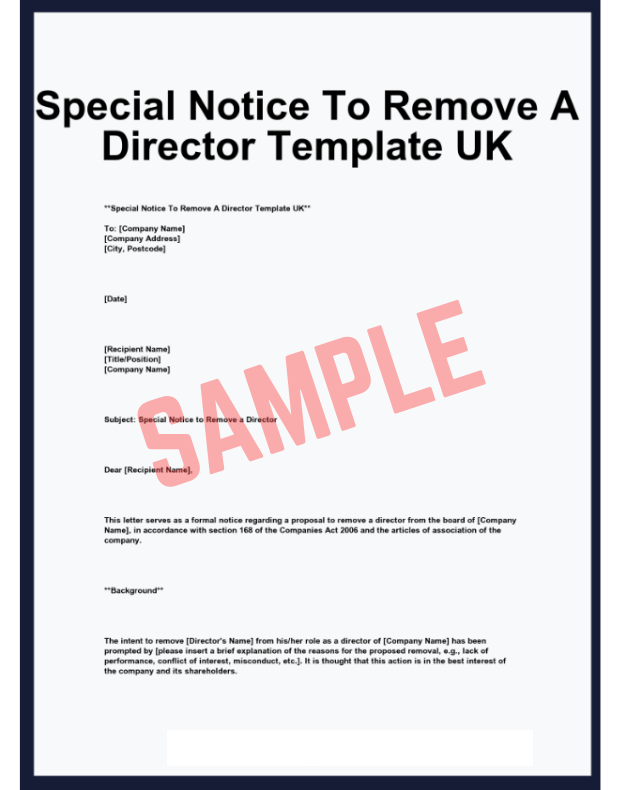
Below is a sample special notice to remove a director template. This example is provided for illustrative purposes only and should be adapted to your specific circumstances, always with legal advice. It outlines the essential components required for a formal notification to the company regarding a proposed director removal. Remember, strict compliance with your company’s Articles of Association and relevant company law (e.g., Companies Act 2006 in the UK) is critical.
SPECIAL NOTICE OF RESOLUTION FOR THE REMOVAL OF A DIRECTOR
To: The Company Secretary
[Company Name]
[Company Registered Address]
[Company Registration Number]
Date: [Date of Notice]
Dear Sir/Madam,
We, the undersigned shareholders of [Company Name], holding [number]% of the total voting rights in the company, hereby give special notice under [Relevant Section of Companies Act, e.g., Section 168 of the Companies Act 2006] of our intention to propose an Ordinary Resolution for the removal of [Director’s Full Name] as a director of the Company.
We require the Company to circulate this Special Notice to all members of the Company, in accordance with the provisions of [Relevant Section of Companies Act, e.g., Section 312 of the Companies Act 2006]. We further require the Company to convene a General Meeting of the Company at the earliest practicable date to consider and, if thought fit, pass the following Ordinary Resolution:
ORDINARY RESOLUTION
“THAT [Director’s Full Name] be and is hereby removed from office as a director of [Company Name] with immediate effect.”
[Optional: If appointing a replacement director]
“AND THAT [Replacement Director’s Full Name], having consented to act, be and is hereby appointed as a director of [Company Name] with immediate effect.”
We understand that the Company is obliged to notify [Director’s Full Name] of this Special Notice and proposed resolution, affording them the opportunity to make representations to the members of the Company.
Please confirm receipt of this Special Notice and advise on the steps being taken to convene the necessary General Meeting.
Yours faithfully,
___________________________
[Shareholder 1 Full Name]
[Shareholder 1 Address]
___________________________
[Shareholder 2 Full Name]
[Shareholder 2 Address]
[Add more shareholder signatures/details as required]
This template begins by clearly addressing the notice to the Company Secretary and includes all necessary company identification details. It then explicitly states the purpose, citing the relevant legal provisions, and names the director to be removed. The exact wording of the Ordinary Resolution is presented, leaving no room for misinterpretation.
The optional clause for appointing a replacement director demonstrates how to combine resolutions for efficiency, if appropriate for your situation. Finally, the notice reminds the company of its obligations regarding circulation and the director’s right to representation, concluding with shareholder signatures and contact information. Always verify the specific sections of your applicable Companies Act and adapt accordingly.
Properly executing the removal of a director requires meticulous attention to detail and strict adherence to legal and procedural guidelines. From understanding the underlying legal framework to carefully drafting the formal notice, each step contributes to a lawful and effective outcome. The sample special notice to remove a director template provided here serves as a practical foundation, highlighting the essential information and structure needed for such a significant corporate action.
While a template offers a valuable starting point, it cannot replace professional legal advice tailored to your specific situation. Company law can be complex, and any misstep in the process could lead to costly delays or legal challenges. Therefore, always consult with legal experts to ensure full compliance and to safeguard your company’s interests throughout this intricate corporate governance process.