Dealing with unpaid debts can be a frustrating and challenging experience for individuals and businesses alike. When friendly reminders and informal requests for payment fail, a formal approach often becomes necessary to recover outstanding money. This is where a legal notice plays a crucial role in initiating the process.
Sending a meticulously drafted legal notice is often the first formal step towards recovering money legally. It signals your seriousness about pursuing the debt and can prompt the debtor to settle the amount without further court intervention. Understanding how to use a robust legal notice for recovery of money template can save you time, stress, and potential legal fees down the line.
This comprehensive guide will walk you through the importance of such a notice, its essential components, and provide you with a practical legal notice for recovery of money template that you can adapt for your specific situation. By the end, you’ll be equipped with the knowledge to draft an effective demand letter and understand the next steps in debt recovery.
Understanding the Importance of a Legal Notice
Before diving into the specifics of a template, it’s vital to grasp why a legal notice is such a powerful tool in debt recovery. It’s more than just a formal letter; it’s a statement of intent that can significantly influence the outcome of a dispute. This initial step can often resolve matters without the need for lengthy and expensive litigation.
Why Send a Legal Notice Before Litigation?
Sending a legal notice serves multiple critical purposes. Firstly, it provides a formal intimation to the debtor about the outstanding amount and your intention to recover it legally. This clarity can sometimes be enough to encourage prompt payment, as it signals that you are serious about enforcing your rights.
Secondly, a legal notice acts as a crucial piece of evidence in any future legal proceedings. It establishes that you made a formal demand for payment and gave the debtor an opportunity to settle the matter amicably. This can strengthen your case significantly if the dispute escalates to court.
Key Elements of an Effective Demand Letter
An effective demand letter for money recovery must contain specific details to be legally sound and persuasive. It should clearly identify both parties involved, precisely state the amount owed, and provide a clear timeline for repayment. Vague or incomplete notices can be easily dismissed by the recipient.
Detailing the origin of the debt, such as the date of the loan, service rendered, or goods supplied, is also crucial. Supporting documents like invoices, agreements, or bounced cheques should be referenced. A clear warning about the consequences of non-payment, including potential legal action, adds weight to the notice.
Legal Implications of Not Sending a Notice
While not always strictly mandatory by law for all types of debt recovery, skipping the legal notice phase can have adverse effects. In many jurisdictions, particularly for cases involving government entities or specific types of contracts, a prior notice is a prerequisite for filing a lawsuit. Failure to send one could lead to your case being dismissed.
Even where not legally required, omitting a formal demand deprives you of a powerful leverage point. It removes the opportunity for an out-of-court settlement and potentially complicates future litigation by not establishing a clear timeline of demands. This can prolong the recovery process and increase legal costs.
Crafting Your Legal Notice for Money Recovery
Drafting a legal notice requires precision and clarity. While a template provides a solid framework, tailoring it to your specific circumstances is paramount. Every detail should be accurate and easily verifiable to avoid any ambiguities that the debtor might exploit.
Essential Information to Include
When preparing your notice, ensure you include the full names and addresses of both the sender (creditor) and the recipient (debtor). Clearly state the exact amount of money due, breaking it down if necessary with principal and interest. The reason for the debt, whether it’s an unpaid loan, goods, or services, must be explicitly mentioned.
Additionally, specify the date by which payment is expected. This deadline should be reasonable, typically 7 to 15 days, allowing the debtor adequate time to respond. Finally, include a statement about the legal actions you intend to take if the payment is not made within the stipulated period.
- Full names and addresses of creditor and debtor
- Precise amount of outstanding money
- Detailed reason for the debt (e.g., loan, services, goods)
- Reference to supporting documents (invoices, agreements)
- Stipulated deadline for payment
- Warning of legal action upon non-payment
- Mode of payment expected
Common Mistakes to Avoid
Many individuals make critical errors when drafting their own legal notices, which can weaken their position. One common mistake is using informal or emotional language; the notice should remain professional and objective. Another error is failing to include all relevant details or misstating the amount owed.
Sending the notice without proper proof of delivery is also a significant oversight. Ensure you have a record that the debtor received the notice. Lastly, avoid making threats that are not legally enforceable, as this can undermine the credibility of your notice and potentially lead to legal counter-actions.
Delivery Methods and Proof of Service
The method of delivery for your legal notice is as important as its content. To ensure legal validity, it is crucial to have undeniable proof that the notice was served to the debtor. This proof will be essential if the matter proceeds to court.
Common and recommended methods include registered post with acknowledgment due, courier services with delivery confirmation, or hand delivery through a process server. Always retain the postal receipts, courier tracking numbers, and delivery confirmations. These documents serve as concrete evidence of service.
Sample Legal Notice For Recovery Of Money Template
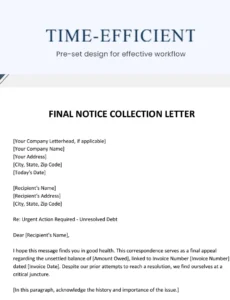
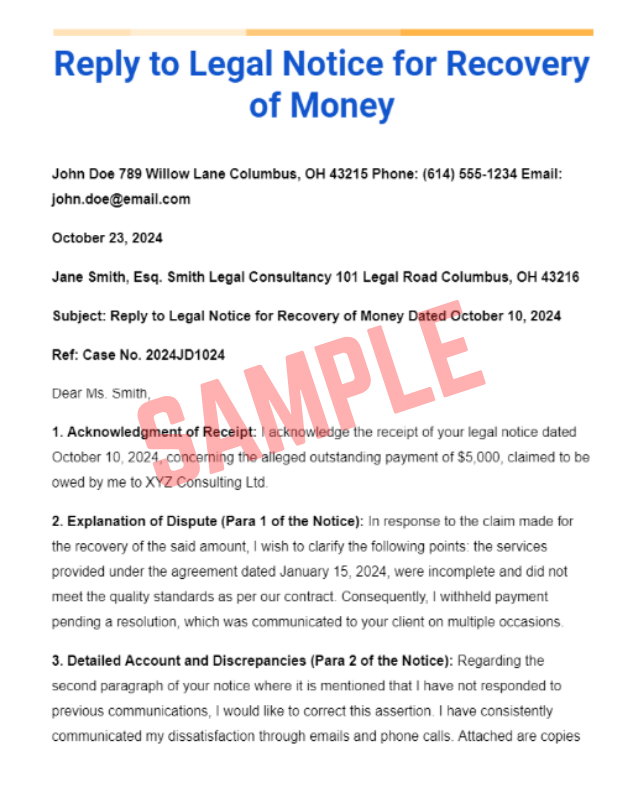
Here is a comprehensive legal notice for recovery of money template that you can adapt. Remember to replace the bracketed information with your specific details. It is always advisable to consult with a legal professional before sending a formal legal notice.
[Your Name/Company Name]
[Your Address]
[City, Pin Code]
[Contact Number]
[Email Address]
Date: [Current Date]
To,
[Debtor’s Name/Company Name]
[Debtor’s Address]
[City, Pin Code]
Subject: Legal Notice for the Recovery of Outstanding Amount of [Amount in Rupees/Dollars]
Dear Sir/Madam,
Under instructions from and on behalf of my client, [Your Name/Company Name], having its office at [Your Address], I hereby serve upon you this Legal Notice.
My client states that you had [briefly describe the transaction, e.g., availed a loan, purchased goods, received services] from my client on [Date of Transaction]. The total amount agreed upon for this transaction was [Total Agreed Amount].
In consideration of the said transaction, you were liable to pay an amount of [Amount to be Recovered] to my client. This amount was due on or before [Due Date of Payment], as per the [Reference to Agreement/Invoice Number/Promissory Note, etc.].
Despite repeated verbal and written reminders from my client, which include [mention any previous reminders, e.g., emails dated X, Y, Z, phone calls], you have failed to make the payment of the outstanding amount of [Amount to be Recovered] till date.
You are hereby called upon to pay the said outstanding amount of [Amount to be Recovered] along with interest at the rate of [Interest Rate]% per annum (if applicable) from [Date from which interest is applicable] until realization, within a period of 15 (fifteen) days from the date of receipt of this notice.
Please note that if you fail to pay the aforesaid amount within the stipulated period, my client shall be constrained to initiate appropriate legal proceedings against you, including but not limited to filing a civil suit for recovery of money, along with claiming interest and costs, entirely at your risk and expense, without any further notice.
A copy of this notice is retained in my office for further necessary action.
Yours faithfully,
[Your Signature]
[Your Name/Company Name]
[Your Designation, if applicable]
[Advocate’s Name, if sent through an advocate]
Utilizing a reliable legal notice for recovery of money template is a crucial first step in asserting your rights as a creditor. It provides a formal, documented demand that can often facilitate an amicable resolution without the need for court intervention. However, it’s equally important to understand the legal framework and ensure your notice is accurate and complete.
Remember that while a template offers a strong foundation, customizing it to reflect the precise details of your situation is vital. By carefully following these guidelines, you increase your chances of successfully recovering your outstanding dues and maintaining professionalism throughout the process. Should the debtor fail to respond adequately, you will have a strong basis to pursue further legal recourse.