Navigating the legal landscape of landlord-tenant relationships in Ohio can be complex, especially when it comes to a landlord’s right to enter a rented property. Understanding proper procedure is crucial for both parties, ensuring tenant privacy is respected while allowing landlords to maintain their investments.
A properly executed 24 hour notice to enter Ohio template is an indispensable tool for landlords. It helps them comply with state law and clearly communicate their intentions to tenants, preventing misunderstandings and potential legal disputes. This guide will walk you through the essential components of Ohio’s landlord entry laws and provide a clear, actionable template you can use.
By following these guidelines, you can maintain a professional and legally compliant approach to property access. We’ll explore when landlords can enter, what constitutes “reasonable notice,” and provide a comprehensive 24 hour notice to enter Ohio template to simplify your process.
Understanding Ohio Landlord Entry Laws
Ohio law establishes clear boundaries regarding when and how a landlord can enter a tenant’s rental unit. These rules are designed to balance a landlord’s need to maintain their property with a tenant’s right to privacy and quiet enjoyment of their home. Adhering to these regulations is not just good practice; it’s a legal obligation.
Failure to provide proper notice or entering without a valid reason can lead to significant issues, including tenant complaints, withholding of rent, or even legal action. Therefore, a solid understanding of these rules is the foundation for any responsible landlord.
When Can a Landlord Enter a Rental Property?
Ohio Revised Code Section 5321.04(A)(8) permits landlords to enter a tenant’s dwelling unit under specific, legitimate circumstances. It’s important to remember that general curiosity or random checks are typically not valid reasons for entry without the tenant’s consent.
- Performing Repairs or Maintenance: This is one of the most common reasons. Landlords must ensure the property remains safe and habitable, requiring access for necessary repairs to plumbing, heating, electrical systems, or structural issues.
- Inspections: Periodically, landlords may need to inspect the property to ensure it’s being maintained properly and to identify any potential issues that require attention. However, these inspections should be reasonable in frequency.
- Showing the Property: If the tenancy is nearing its end and the landlord plans to re-rent or sell the property, they have the right to show it to prospective tenants or buyers.
- Emergency Situations: In genuine emergencies, such as a fire, significant water leak, or gas smell, a landlord can enter immediately without prior notice. The safety of the property and its occupants takes precedence.
- By Agreement: A landlord can always enter if the tenant explicitly agrees to allow entry, even if it’s for a reason not typically covered by the above points. This agreement should preferably be in writing.
What Constitutes “Reasonable Notice” in Ohio?
For most non-emergency entries, Ohio law specifies that landlords must give “reasonable notice” of their intent to enter. While “reasonable” can sometimes be subjective, the statute generally interprets this as at least 24 hours’ advance notice.
This 24-hour period provides the tenant with enough time to prepare for the entry or to make alternative arrangements if they prefer not to be present. The notice should clearly state the date and approximate time frame of entry, as well as the reason for entry.
While verbal notice might be accepted in some cases, providing written notice is always the safest and most professional approach. A written notice leaves a clear record, preventing disputes over whether notice was given, when, and for what reason. This is where a proper 24 hour notice to enter Ohio template becomes invaluable.
Tenant Rights Regarding Landlord Entry
Tenants in Ohio possess several rights that protect their privacy concerning landlord entry. The primary right is the right to “quiet enjoyment” of their rented premises, which means they should not be disturbed by unreasonable or frequent landlord intrusions.
If a landlord repeatedly enters without proper notice or for invalid reasons, a tenant may have grounds to take legal action. This could include seeking an injunction to stop the unauthorized entries, or in severe cases, the tenant might be able to terminate the lease or sue for damages.
Therefore, understanding and respecting these tenant rights by always using a formal notice process, such as a 24 hour notice to enter Ohio template, is essential for landlords to avoid legal complications and maintain a positive relationship with their tenants.
Crafting an Effective 24 Hour Notice To Enter Ohio Template
Creating a clear and legally sound notice for entry doesn’t have to be complicated. By including all the necessary information and using a consistent format, you can ensure your communication is professional and compliant with Ohio law. An effective notice protects both the landlord and the tenant.
The goal is to leave no room for ambiguity regarding the landlord’s intent, the reason for entry, and the specific timing. This attention to detail builds trust and minimizes potential friction between parties.
Essential Elements of a Valid Notice
For your 24 hour notice to enter Ohio template to be legally sound and effective, it must contain several key pieces of information. Missing any of these elements could render the notice invalid or cause confusion for the tenant.
- Date of Notice: The exact date the notice is being issued. This helps establish the 24-hour timeframe.
- Tenant(s) Name(s): Clearly identify all adult tenants named on the lease.
- Property Address: The full address of the rental unit being entered.
- Reason for Entry: A clear, concise, and legitimate reason for the visit (e.g., “to perform scheduled plumbing repairs,” “to conduct a semi-annual property inspection,” “to show the property to prospective tenants”).
- Date of Entry: The specific date on which the landlord intends to enter the property.
- Time of Entry: A reasonable window of time for entry (e.g., “between 10:00 AM and 1:00 PM”). Avoid vague times like “sometime during the day.”
- Landlord’s Name and Contact Information: The name of the landlord or property manager and a phone number or email address where they can be reached for questions.
- Signature of Landlord/Agent: A formal signature provides authenticity.
Including all these details ensures that the tenant receives complete information and understands their rights and what to expect. A well-prepared 24 hour notice to enter Ohio template streamlines this process.
Tips for Delivering the Notice Legally
Providing the notice isn’t enough; it must be delivered in a manner that ensures the tenant actually receives it and that you can prove delivery if necessary. Ohio law does not explicitly dictate the method of notice for entry, but best practices suggest methods that create a clear record.
Hand-delivering the notice directly to the tenant is often the most direct method. If the tenant is not home, posting the notice prominently on the main entry door of the rental unit is a common practice and generally considered acceptable. Another effective method is sending the notice via first-class mail, perhaps even certified mail with a return receipt for added proof of delivery.
Some landlords also use email, especially if the lease agreement specifies email as an acceptable form of communication for notices. However, always have a backup method in case email delivery fails or is disputed. Keeping a copy of the notice for your records is always a smart move, regardless of the delivery method chosen.
Sample 24 Hour Notice To Enter Ohio Template
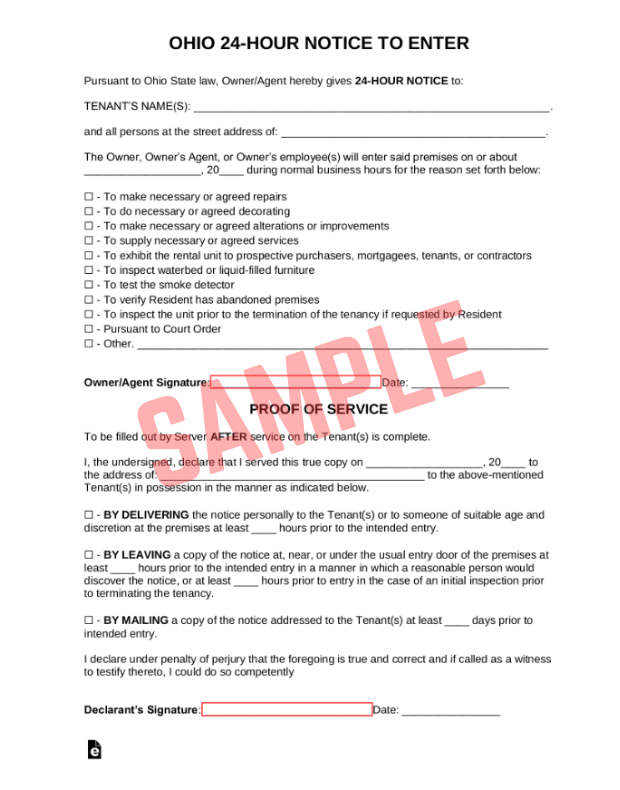
Using a standardized notice form not only saves time but also ensures consistency and legal compliance. Below is a practical example of a 24 hour notice to enter Ohio template that you can adapt for your specific needs. Remember to fill in the bracketed information with the relevant details for your situation.
This template covers all the essential information discussed previously, providing a clear and professional document for your landlord-tenant communications.
[Your Name/Company Name] [Your Address] [Your City, OH, Zip Code] [Your Phone Number] [Your Email Address]
Date: [Current Date]
NOTICE OF INTENT TO ENTER DWELLING UNIT
To: [Tenant’s Full Name(s)] From: [Your Name/Company Name], Landlord/Property Manager Property Address: [Full Address of Rental Property, including Unit # if applicable] City, State, Zip: [City, OH, Zip Code]
Please be advised that pursuant to Ohio Revised Code Section 5321.04(A)(8), this serves as a formal notice of our intent to enter your dwelling unit located at the above-referenced address.
Purpose of Entry: [Clearly state the reason for entry. Examples: – To perform scheduled maintenance on the HVAC system. – To conduct a routine semi-annual property inspection. – To show the property to prospective tenants/buyers. – To assess and repair a reported plumbing leak.]
Date of Entry: [Specific Date of Proposed Entry] Time of Entry: [Specific Time Window, e.g., “between 10:00 AM and 12:00 PM”]
We will make every effort to minimize disruption during our visit. You are not required to be present at the time of entry, but you are welcome to be if you wish.
If this date or time presents a significant conflict, please contact us immediately at [Your Phone Number] or [Your Email Address] to discuss alternative arrangements. While we will do our best to accommodate reasonable requests, please understand that some entry times may be essential for timely property maintenance or showing schedules.
Thank you for your cooperation and understanding.
Sincerely,
___________________________ [Your Printed Name/Company Name] Landlord/Property Manager
Utilizing a comprehensive 24 hour notice to enter Ohio template like this ensures that you meet all legal requirements and communicate effectively with your tenants. It serves as a clear record of your compliance and professional conduct.
By consistently using such a template, landlords can foster transparency and trust, reducing the likelihood of misunderstandings or disputes over property access. This approach benefits both parties by setting clear expectations and adhering to legal protocols.