Navigating the complexities of employment law can be a daunting task for any business, especially when it involves hiring decisions based on background checks. A single misstep can lead to significant legal challenges, fines, and reputational damage. Ensuring compliance with the Fair Credit Reporting Act (FCRA) is paramount, and a crucial component of this is understanding and properly utilizing a pre-adverse action notice template.  This article will delve into the critical aspects of pre-adverse action notices, explaining their purpose, outlining the essential elements, and providing practical guidance to help your organization stay compliant. By the end, you’ll have a clearer understanding of how to implement these notices effectively, protecting both your business and prospective employees.
Understanding the Pre-Adverse Action Notice Requirement
When an employer considers taking a negative employment action—such as rescinding a job offer or not promoting an employee—based even partially on information from a consumer report (like a background check), federal law mandates a specific process. This process includes providing the individual with a pre-adverse action notice. It’s a critical step that allows the candidate to understand and potentially dispute the information.
The Fair Credit Reporting Act (FCRA) is the primary federal law governing these notices. It ensures that individuals have the right to know what information is being used against them and the opportunity to correct any inaccuracies. Skipping this vital step can result in severe penalties and lawsuits for employers, emphasizing the importance of a compliant pre-adverse action notice template. This notice is not the final decision but rather a preliminary warning.
Key Components of an Effective Pre-Adverse Action Notice Template
A well-drafted pre-adverse action notice template must include several specific pieces of information to comply with FCRA regulations. These components ensure the candidate receives all necessary details to understand the situation and exercise their rights. Missing any element can render the notice non-compliant.
Below are the essential elements typically found in a robust and legally sound pre-adverse action notice:
- Statement of Intent: Clearly state that the employer is considering adverse action based on information in a consumer report.
- Copy of the Consumer Report: The notice must be accompanied by a complete copy of the background check report that led to the potential adverse decision.
- Summary of Rights: Include a copy of “A Summary of Your Rights Under the Fair Credit Reporting Act,” provided by the consumer reporting agency (CRA).
- CRA Contact Information: Provide the name, address, and phone number of the consumer reporting agency that prepared the report.
- Reason for Action: Briefly explain the specific information from the report that is influencing the potential adverse action.
- Opportunity to Dispute: Inform the candidate of their right to dispute the accuracy or completeness of any information in the consumer report with the CRA.
- Response Period: Specify a reasonable period (typically five business days) during which the candidate can review the report and respond. This allows them to clarify or dispute the findings before a final decision is made.
Having a standardized pre-adverse action notice template helps ensure consistency and legal adherence across all potential adverse action scenarios.
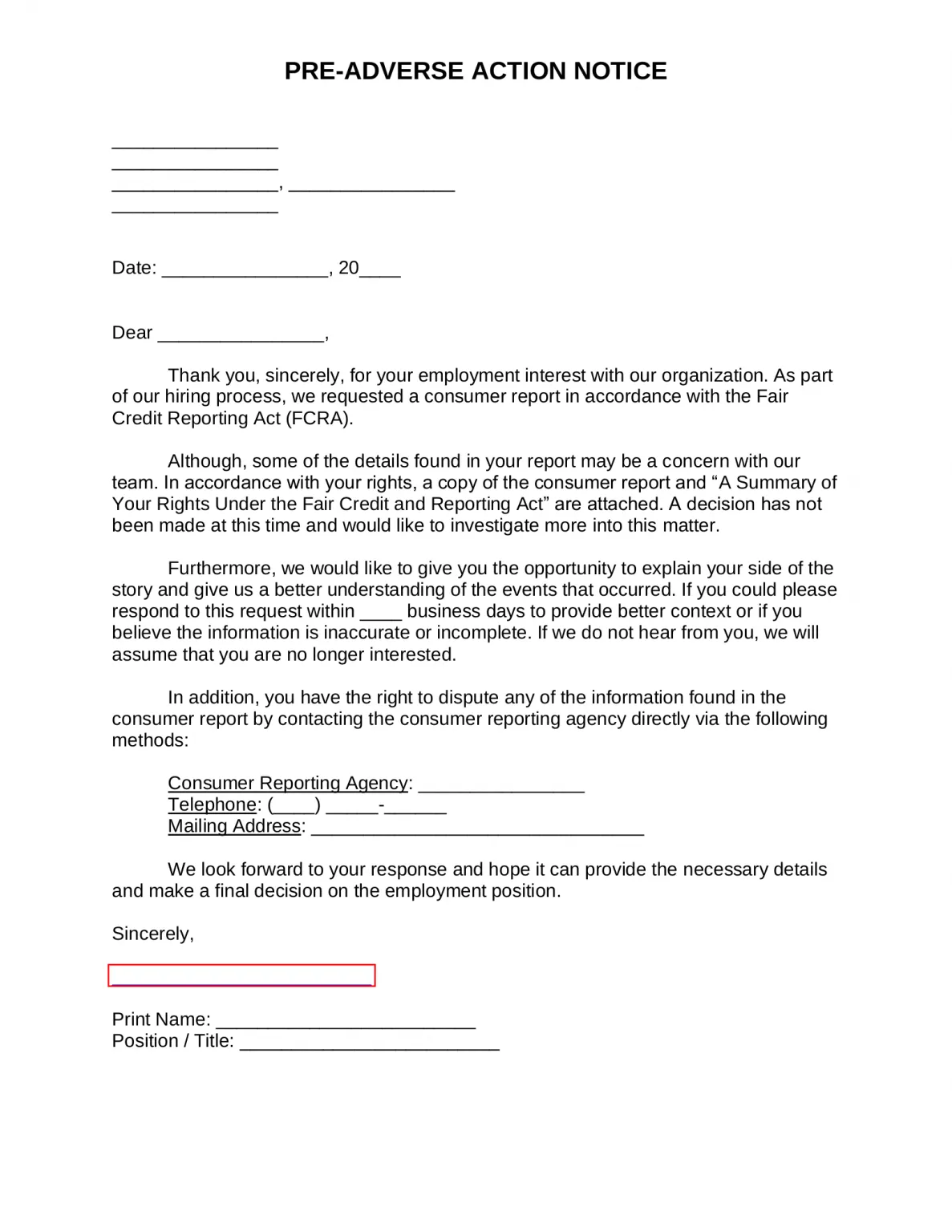
Sample Pre-Adverse Action Notice Template
Here is a simplified example of what a pre-adverse action notice might look like:
[Your Company Letterhead]

[Date]

[Applicant/Employee Name]
[Applicant/Employee Address]

Subject: Important Information Regarding Your Application/Employment

Dear [Applicant/Employee Name],

This letter serves as a pre-adverse action notice regarding your application for [Position Name] / your current employment status. We are considering taking adverse action based, in whole or in part, on information contained in a consumer report (background check) obtained from [Name of Consumer Reporting Agency].

Enclosed with this letter, you will find a copy of your consumer report and "A Summary of Your Rights Under the Fair Credit Reporting Act." We encourage you to review these documents carefully.

The information from the report that is being considered in our decision includes [Briefly state specific information, e.g., "a criminal conviction for X offense on Y date" or "discrepancies in your employment history"].

You have the right to dispute the accuracy or completeness of any information in the consumer report directly with the consumer reporting agency. Their contact information is:
[Name of Consumer Reporting Agency]
[Address of Consumer Reporting Agency]
[Phone Number of Consumer Reporting Agency]
[Website, if applicable]

You also have the right to contact us to discuss the information in your report. We will delay our final decision for a reasonable period, typically five (5) business days from the date of this letter, to allow you time to review the report and respond. If we do not hear from you within this timeframe, we may proceed with our final decision.

Sincerely,

[Your Name/HR Department]
[Your Title]
[Your Contact Information]
Steps Following a Pre-Adverse Action Notice
Issuing a pre-adverse action notice is not the end of the process; it’s a critical 중간 step. Once the notice and accompanying documents are sent, the employer must wait for the specified response period to elapse. Typically, this waiting period is five business days, though some states or jurisdictions may require a longer duration. During this time, the individual has the opportunity to review the background report, identify any inaccuracies, and dispute them with the consumer reporting agency.
The individual might also contact the employer directly to explain or provide context regarding the findings in the report. Employers should have a clear process for handling these communications and considering any additional information provided. Only after the waiting period has passed and any provided explanations have been considered can an employer move forward with a final adverse action decision. If the decision is still adverse, a separate “adverse action letter” must be sent.
Utilizing a reliable pre-adverse action notice template is a cornerstone of compliant hiring practices. By ensuring your organization adheres to these vital FCRA requirements, you protect your business from legal risks and foster fair and transparent hiring processes. Implementing a clear, consistent approach helps maintain integrity and trust in every stage of your employment screening.