Navigating employee performance or conduct issues can be one of the most challenging aspects of human resource management. Addressing these situations effectively requires clear communication, consistency, and proper documentation. A well-structured process ensures fairness for the employee and legal protection for the organization.  This is where a robust disciplinary notice to employee template becomes an indispensable tool. It provides a standardized framework for communicating serious concerns, outlining expectations for improvement, and detailing potential consequences. Understanding how to use such a template can significantly streamline your HR processes and safeguard your company’s interests.
Crafting an Effective Disciplinary Notice to Employee Template
Developing a comprehensive disciplinary notice to employee template is crucial for any organization. This document serves as an official record of an employee’s misconduct or performance deficiencies. It also outlines the necessary steps for resolution and adherence to company policies. Clear communication prevents misunderstandings and ensures a transparent disciplinary process.
Several key elements must be included in any effective disciplinary action letter. These components ensure the notice is thorough, fair, and legally sound. Each section plays a vital role in documenting the issue and guiding the employee towards corrective action. Failing to include specific details can weaken the company’s position.
Here are the essential elements typically found in a well-designed disciplinary notice:
- Employee Information: Full name, job title, department, and employee ID.
- Date of Notice: The specific date the notice is issued.
- Date(s) of Incident: The exact date or range of dates when the alleged misconduct or performance issue occurred.
- Nature of Violation/Performance Issue: A clear and concise description of the problem, referencing specific company policies if applicable.
- Previous Discussions/Warnings: Details of any prior informal or formal conversations regarding the issue, including dates.
- Expected Corrective Action: Specific, measurable steps the employee must take to resolve the issue.
- Timeline for Improvement: A reasonable timeframe within which the employee is expected to demonstrate improvement.
- Consequences of Non-Compliance: A clear statement of the further disciplinary actions, up to and including termination, if improvements are not met.
- Employee’s Right to Respond: Information on how the employee can provide their version of events or appeal the decision.
- Signatures: Spaces for HR, manager, and employee signatures, acknowledging receipt of the notice.
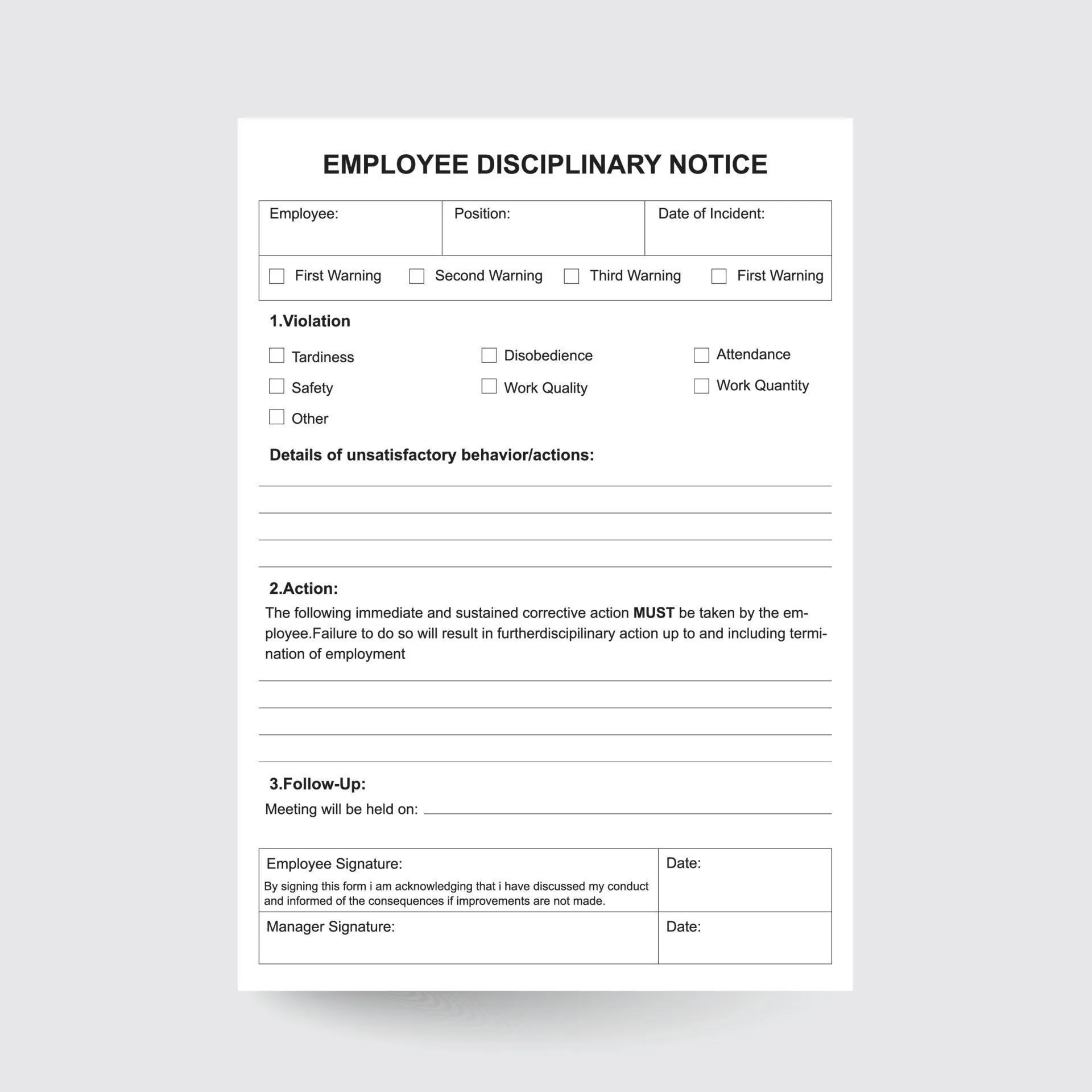
Below is a sample disciplinary notice to employee template designed to be adaptable for various workplace situations. Remember to customize all bracketed information to fit your specific circumstances. This formal warning letter ensures consistency across all disciplinary proceedings within your organization.
[Company Letterhead]

Date: [Date of Notice]

Employee Name: [Employee's Full Name]
Job Title: [Employee's Job Title]
Department: [Employee's Department]
Employee ID: [Employee's ID Number]

Subject: Formal Disciplinary Notice – [Nature of Violation/Performance Issue]

Dear [Employee's Full Name],

This letter serves as a formal disciplinary notice regarding [briefly state the core issue, e.g., your consistent tardiness, your failure to meet sales targets, your violation of the company's dress code policy]. This action is being taken in accordance with our company's policies and procedures regarding [mention relevant policy, e.g., attendance, performance, workplace conduct].

On [Date(s) of Incident], you [describe specific incident(s) or pattern of behavior in factual, objective terms. Include dates, times, and locations if relevant. For example: "On October 26, 2023, you arrived 30 minutes late for your shift without prior notification. This follows similar incidents on October 20 and October 23."]. This behavior constitutes a violation of [cite specific company policy, e.g., Company Policy 3.1: Attendance, Employee Handbook Section 4: Performance Expectations].

We have previously discussed these concerns with you on [Date(s) of Previous Discussions, e.g., "during our informal meeting on October 15, 2023"]. Despite these discussions, the issue persists.

To resolve this matter, you are required to take the following corrective actions immediately:
1.  [Specific action 1, e.g., "Adhere strictly to your scheduled work hours, ensuring you arrive on time every day."]
2.  [Specific action 2, e.g., "Submit a daily progress report on your sales activities by 5:00 PM."]
3.  [Specific action 3, e.g., "Review and confirm understanding of the company's dress code policy."].

We expect to see immediate and sustained improvement in your [area of concern, e.g., attendance, performance, conduct] within [Number] days/weeks, specifically by [Date for Review]. Your manager, [Manager's Name], will meet with you on [Date of Follow-Up Meeting] to review your progress.

Failure to meet these expectations and demonstrate satisfactory improvement will result in further disciplinary action, which may include, but is not limited to, suspension without pay, demotion, or termination of employment.

You have the right to provide a written response to this disciplinary notice within [Number] business days of receipt. Your response will be added to your personnel file. If you wish to discuss this matter further, please contact [HR Representative/Manager's Name] by [Date].

We are committed to helping you succeed in your role and encourage you to utilize any available company resources to assist you in meeting these expectations.

Sincerely,

[HR Representative/Manager's Name]
[Title]
[Company Name]

Acknowledged by Employee:

_____________________________
[Employee's Full Name]
Date: [Date]
Implementing a clear and consistent disciplinary notice process is vital for maintaining a productive and respectful workplace. This structured approach helps ensure all employees understand expectations and the consequences of not meeting them. It also provides a defensible record should any legal challenges arise concerning employee discipline.
By utilizing a standardized disciplinary notice to employee template, organizations can foster a culture of accountability and fairness. This not only supports employee growth and development but also protects the company from potential disputes. Regular review and adaptation of your template will keep it relevant and effective.