Navigating the complexities of payment in contractual agreements, especially within the construction industry, can be challenging. Disputes over payments are common, and understanding your rights and obligations is crucial to maintaining healthy cash flow and avoiding legal pitfalls. One critical tool in managing these situations is the pay less notice, a formal document used to inform a payee that the payer intends to pay less than the amount stated in a payment application or invoice.
Having a reliable pay less notice letter template at your disposal can save significant time and stress, ensuring you adhere to legal requirements and protect your financial interests. This article will guide you through the essential components of such a notice, its importance, and provide a practical template to help you confidently manage payment variations. We’ll explore how to effectively communicate your intent to pay less, safeguarding your position in contractual agreements.
Understanding the Purpose of a Pay Less Notice
A pay less notice is a formal document, often a statutory requirement in jurisdictions like the UK under the Housing Grants, Construction and Regeneration Act (HGCRA), that allows a payer to notify a payee of their intention to pay less than the sum applied for. This notice is not merely a courtesy; it’s a legal safeguard that prevents the default payment of the full amount requested, even if that amount is disputed. Without a valid notice, you may be liable for the full sum claimed.
Issuing this notice correctly and on time is paramount. It must clearly state the amount the payer intends to pay and the reasons for paying less than the applied sum. This process ensures transparency and gives the payee an opportunity to understand the basis of the reduced payment, potentially opening a dialogue for resolution before disputes escalate. Failing to issue a proper notice within the stipulated timeframe can severely impact your contractual rights and financial standing.
The notice acts as a formal declaration, outlining why certain works or services are not being paid for at the initially requested rate, or why deductions are being made. This might be due to defective work, delays, contra-charges, or disagreements over the valuation of completed stages. Its proper use is fundamental to sound financial management and dispute avoidance in contract administration.
Key Elements of an Effective Pay Less Notice Letter Template
To be legally valid and effective, a pay less notice letter template must include several crucial pieces of information. These elements ensure clarity, transparency, and compliance with contractual and statutory requirements. Missing any of these details could render the notice ineffective, leaving the payer liable for the full amount applied for.
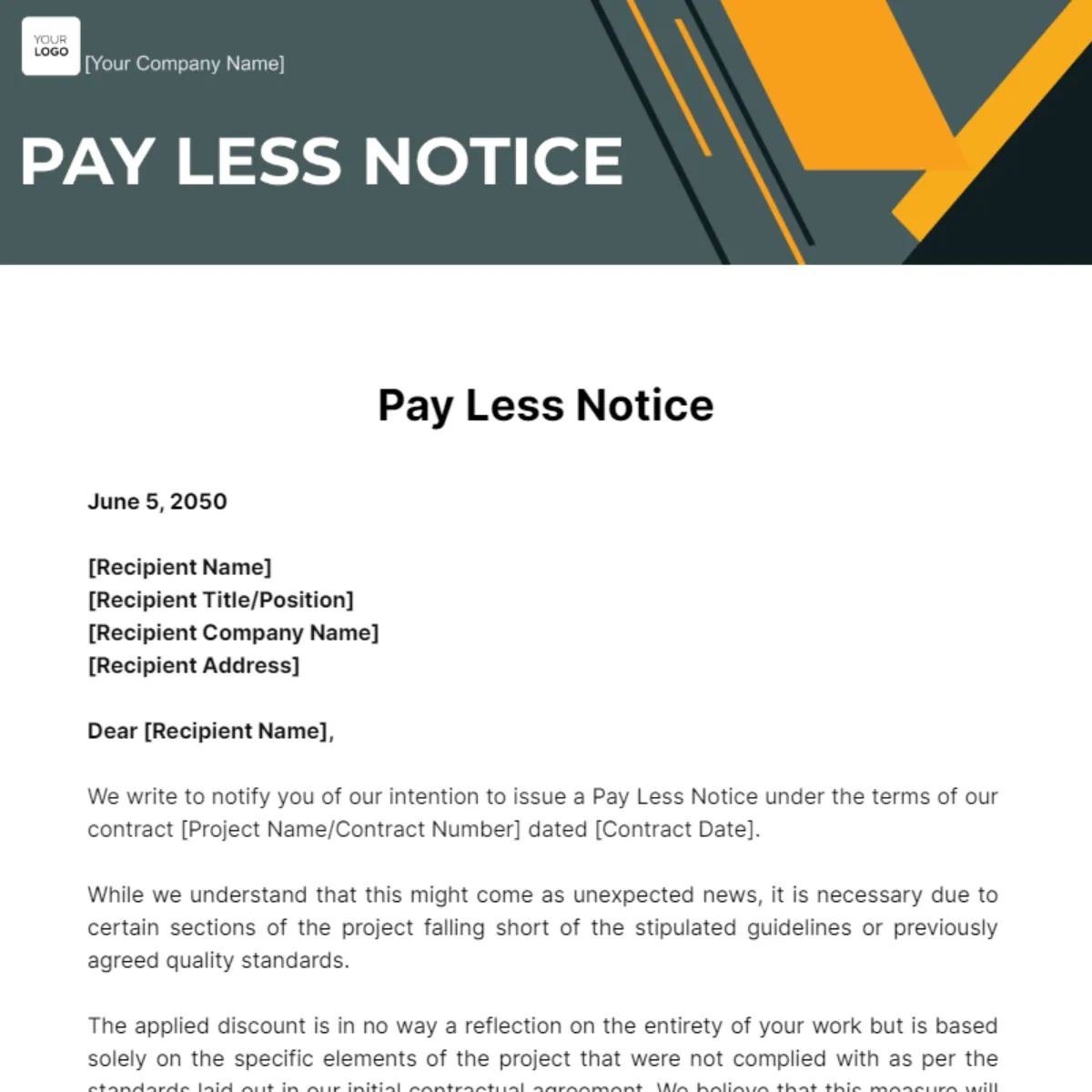
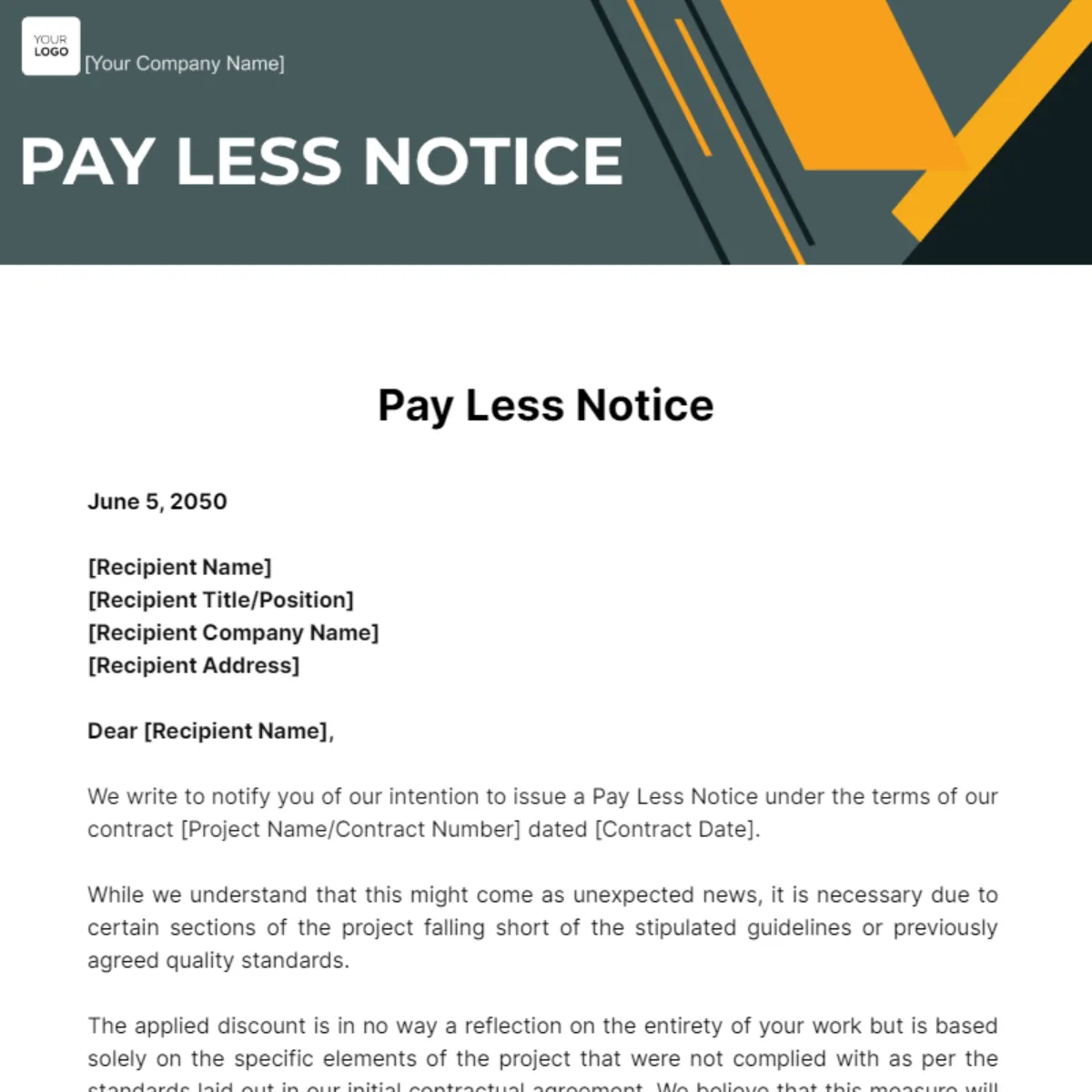
The template should explicitly state the project details, the original payment application it relates to, and the specific reasons for the intended reduction. It must clearly articulate the sum that will actually be paid, ensuring there is no ambiguity. Below is a sample pay less notice letter template demonstrating these essential components.
Sample Pay Less Notice Letter Template
[Your Company Letterhead]
[Date]
[Payee Company Name] [Payee Company Address]
Subject: Pay Less Notice in relation to Payment Application No. [Original Application Number] for [Project Name]
Dear [Contact Person Name],
This letter serves as a formal Pay Less Notice in accordance with Clause [Relevant Contract Clause Number] of our contract dated [Contract Date] for the [Project Name] project at [Project Address]. It relates specifically to Payment Application No. [Original Application Number] received on [Date Payment Application Received].
We acknowledge receipt of your Payment Application No. [Original Application Number] requesting payment of £[Original Applied Amount]. However, we intend to pay less than the amount stated in your application for the reasons detailed below.
The sum we intend to pay is £[Intended Payment Amount]. This figure is derived as follows:
- Original Applied Amount: £[Original Applied Amount]
- Less deductions for:
- [Reason 1 for deduction, e.g., Unrectified defects identified in site inspection on XX/YY/ZZZZ]: £[Amount Deducted 1]
- [Reason 2 for deduction, e.g., Liquidated damages for delay from XX/YY/ZZZZ to XX/YY/ZZZZ]: £[Amount Deducted 2]
- [Reason 3 for deduction, e.g., Valuation discrepancy for item X, as per Bill of Quantities]: £[Amount Deducted 3]
- Total Deductions: £[Sum of all deductions]
- Net Sum Payable: £[Intended Payment Amount]
Full particulars of the basis for these deductions and the calculation of the intended payment amount are provided in Appendix A, attached to this notice. We are committed to resolving any discrepancies efficiently and promptly.
Please note that this notice is issued within the statutory and contractual timeframe. We expect to make the payment of £[Intended Payment Amount] by [Payment Due Date].
Should you have any queries or require further clarification regarding this notice, please do not hesitate to contact [Your Name/Department] at [Your Phone Number] or [Your Email Address].
Yours sincerely,
[Your Name] [Your Title] [Your Company Name]
Common Pitfalls to Avoid When Issuing a Pay Less Notice
While a well-crafted pay less notice letter template is an excellent starting point, knowing common mistakes to avoid is equally important. Errors in issuing this notice can have severe financial and legal repercussions, potentially forcing you to pay the full amount of an invoice even if you have legitimate grounds for reduction. Diligence and attention to detail are critical to ensuring the notice is effective and enforceable.
One of the most frequent errors is failing to issue the notice within the specified contractual or statutory timeframe. Each contract will stipulate a deadline for submitting a pay less notice, usually a number of days before the final payment due date. Missing this deadline renders the notice invalid, and you could lose your right to withhold payment. Another common pitfall is providing insufficient detail for the reasons for deduction. The notice must clearly and comprehensively explain why you are paying less, with supporting evidence or calculations, not just state an arbitrary reduced figure.
Furthermore, ensure the notice is sent to the correct recipient and through the designated communication channels outlined in the contract. Sending it to the wrong person or via an unapproved method might lead to claims that the notice was never properly received. Always keep proof of dispatch, such as a recorded delivery receipt or an email read receipt, to confirm timely delivery. Avoiding these common mistakes will bolster the efficacy of your pay less notice and protect your contractual position.
Effectively managing payment variations in contractual agreements is a cornerstone of sound business practice, particularly in complex sectors like construction. Utilizing a meticulously prepared pay less notice letter template empowers you to formally communicate your intent to pay a reduced sum, adhering strictly to legal and contractual obligations. This proactive approach helps to prevent unwarranted payments and provides a clear framework for resolving potential disputes before they escalate.
Remember that while a template provides a solid foundation, each situation is unique, and professional legal advice should always be sought for specific cases or complex payment disputes. By understanding the critical elements, adhering to deadlines, and avoiding common pitfalls, you can confidently navigate payment challenges and safeguard your financial interests. Leverage these insights to manage your contractual relationships effectively and maintain transparency in all payment communications.